Campus Life
- Photo Gallery
- School Ethos and
Student Support - Healthy Campus
- School Teams
and After-School Activities - Saturday Extracurricular
Interest Classes - 70th Anniversary
Celebration
School Ethos and
Student Support
Discipline & Guidance Section
Student Development and Guidance Philosophy
-
Integrating “discipline, guidance, and spiritual development” to emphasize students’ spiritual growth and moral education.
-
Upholding the school motto, “Be humble and courteous; advance in virtue; pursue knowledge through diligent study,” to cultivate self-discipline, confidence, perseverance, and responsibility.
-
Establishing positive and proactive values and life attitudes to help students face learning and developmental challenges.
-
Adopting a whole-school participation model for guidance work, fostering a harmonious, orderly, caring, and disciplined campus through the joint efforts of all teachers, students, and parents.
Awards
-
Positive Learning Campus Recognition Scheme 2025 – Awarded “Positive Learning Campus Recognition Award”.
-
Caring Schools Award Scheme – Received the “Caring School” honor for multiple consecutive years.
-
Jockey Club “One for All, All for Good” Volunteer Promotion School Partnership Programme – Awarded “Kindness Campus”.
-
“4Rs Mental Health Charter” – Recognized as a “Mental Health Friendly Organization”.
Features of Discipline & Guidance Activities
-
Life Planning: Helping students understand their potential, set goals, and lay foundations for future development.
-
Volunteer Service: Allowing students to experience the joy of giving and develop social responsibility and empathy.
-
Mental Health Activities: Strengthening students’ resilience, gratitude, and positive mindset in facing challenges.
-
Leadership Training: Offering opportunities to develop leadership skills and team spirit.
-
Positive Reinforcement: Enhancing positive behaviors and creating an optimistic, energetic school environment.
School-based Discipline & Guidance Activities
-
Birthday Casual Wear Day
-
Perseverance Month
-
Cleanliness Month
-
Inter-class Discipline Competition
-
Inter-class Cleanliness Competition
-
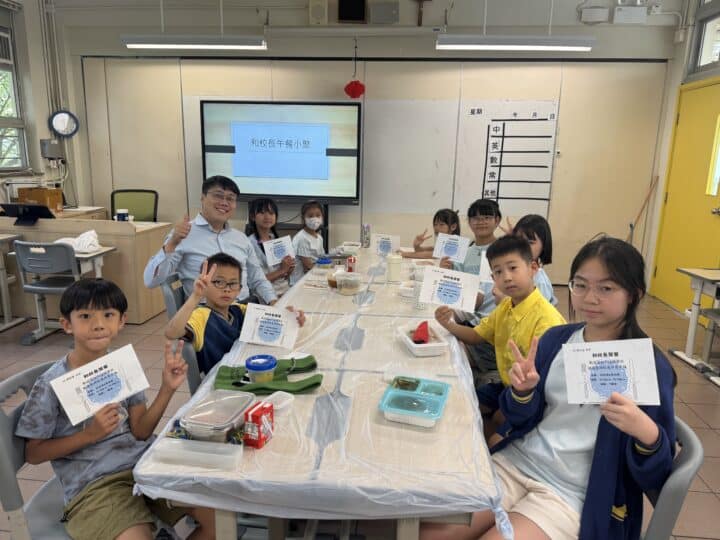
Lunch Gathering with the Principal
-
Fuk Tak Children’s Growth Milestones
-
Primary One 100th Day Celebration
-
Prefect Training
-
Big Brother Big Sister Mentorship Programme
-
Mental Health Day
-
Life Simulation Social Experience
-
“Shrimp Kids Caring for the Elderly” Community Network Project
-
Stars of the Month
Class Management Activities
-
Classroom Agreement (N + 1)
-
“Love Returning to School” Class Photo at School Opening
-
4R Class Teacher Lessons
-
One Student, One Responsibility
-
Secret Angel Caring Programme
Collaborative Projects with External Organizations
-
P1: Playright Children’s Play Association – Free Play Experience
-
P2: Be Priceless – Little Seeds Health Programme
-
P3: UpPotential – Unlimited Potential Youth Caring Programme
-
P4: Education Bureau – School-based Mental Health Literacy Resource Support Programme
-
P5 & P6: Jockey Club – One for All, All for Good Volunteer Promotion School Partnership Programme
-
P1–P6: Jockey Club Buddy Up! Anti-Bullying Programme
Student Support Section Introduction
The Student Support Section plans, coordinates, and promotes student support services using a whole-school approach, providing diverse and appropriate support to all students. Through the “Early Identification” mechanism and the “Three-Tier Support Model,” the section offers professional assessments, enhanced counseling, Individual Education Plans (IEPs), classroom support, small-group support, homework adjustments, and more for students with Special Educational Needs (SEN).
Objectives of the Student Support Section
-
Implement whole-school participation so all staff share responsibility for supporting students with diverse educational needs.
-
Use early identification to detect students with learning difficulties and provide timely support.
-
Establish early intervention policies and coordinate systematic school-based support.
-
Promote home–school cooperation to deepen parents’ understanding, support, and involvement in SEN services.
-
Foster cross-disciplinary collaboration among teachers, educational psychologists, speech therapists, counselors, social workers, and others.
-
Regularly review and improve support services.
Student Support Section Programmes
-
Speech therapy
-
Occupational therapy – fine motor skills training
-
Academic support
-
English classes for newly arrived students
-
Support for students with dyslexia or weaker academic performance:
-
English Learning Support Class
-
Chinese Reading & Writing Fun (P1–P2)
-
After-school Chinese Creative Writing Group (P3)
-
Chinese Learning Skills Group (P4)
-
Chinese Reading & Writing Club (P5–P6)
-
-
Support for students with intellectual disabilities:
-
“FUN FUN Social Group”
-
Curriculum accommodations as needed
-
-
Support for students with Autism Spectrum Disorder:
-
AIM Whole-school Tiered Support
-
“Social Thinking” individual guidance
-
-
Support for students with ADHD:
-
Participation in “Jockey Club InnoPower Movement”
-
“Attention Agents” skills training group
-
-
Students needing emotional or expressive support:
-
“Fun Kick” Children’s Football Team
-
Play therapy
-
-
Support for junior primary students’ adjustment and learning skills:
-
Adventure camp to build independence, self-care, confidence
-
-
Chinese language support class for non-Chinese-speaking students
Whole-school Approach to Inclusive Education (2024/2025)
1. Policy
-
Care for SEN students through whole-school participation, building a harmonious, orderly, caring campus culture.
-
Early identification of SEN students’ needs to provide suitable support.
2. Resources
Additional funding allocated by the Education Bureau to support SEN and lower-performing students, including:
-
Learning Support Grant
-
Grant for Supporting NCS SEN Students
-
School-based Educational Psychology Service Grant
-
Enhanced School-based Speech Therapy Grant
3. Support Measures & Use of Resources
The school provides the following measures:
-
Appointment of SENCO (Special Educational Needs Coordinator).
-
Establishment of a Student Support Team consisting of principal, SENCO, SEN teachers, class teachers, subject teachers, social workers, educational psychologists, speech therapists, and teaching assistants.
-
“Split-class group teaching” in P2 Chinese, English, and Mathematics.
-
After-school tutoring in Chinese, English, Mathematics for lower-performing students.
-
Various school-based and outsourced Chinese reading/writing support groups for P1–P6.
-
Outsourced P1 learning skills training group.
-
Outsourced English learning support class.
-
“Attention Agents” focus training group for ADHD students.
-
Drama-based social skills group for ASD students.
-
Interest groups to develop talents and learning motivation.
-
Participation in Jockey Club programmes and EDB commissioned AIM Project for focus and social-emotional training.
-
Outsourced play therapy and occupational therapy.
-
Individual Education Plans (IEPs) for Tier-3 students.
-
School-based educational psychologist providing ~30 days of support per year.
-
Referral procedures for urgent and non-urgent cases.
-
On-site speech therapy 3 days per week.
-
Adjustments in homework, dictation, examinations, and curriculum for SEN students.
-
Early detection using the P1 Learning Difficulties Checklist.
-
Parent education: talks, workshops, training groups to support SEN understanding and inclusive culture.
-
Teacher professional development on differentiated instruction (training conducted on 27/9/2024 and 8/1/2025), with over 90% expressing increased capability and intention to adopt inclusive strategies.
-
Additional teachers completed foundational and advanced courses on supporting students with diverse learning needs.
Healthy Campus
Nutritious Campus
- Our school has established a “School Healthy Eating Policy” and is committed to creating a healthy eating environment. We continuously promote a culture of healthy eating among students, staff, and parents, and help students develop good eating habits.
- Our efforts have been recognized by the Department of Health. Since May 2015, our school has been awarded the title of “EatSmart School” and has obtained the Basic Certification, the “Quality Healthy Lunch Certification,” and the “Quality Healthy Snacks Certification.”
Developing Healthy Eating Principles
Preparing Your Own Lunches in the “3:2:1” Proportion
- Parents may refer to the Nutritional Guidelines for Primary School Students’ Lunches to prepare healthy lunches for their children.
- The ratio of grains, vegetables, and meat should be 3:2:1 respectively (i.e., the largest portion should be rice/noodles/pasta, followed by vegetables, and the smallest portion should be meat). Processed ingredients should be avoided, and no desserts should be included.
- Lunches should not contain foods listed under “strongly discouraged,” such as deep-fried items, salted fish, salted eggs, Chinese sausages, or other high-salt foods. Cooking and food choices should follow the principles of “three lows and one high” (low salt, low sugar, low fat, and high fiber).
Healthy Snacks
- Parents should prepare healthy and appropriately sized snacks for their children, ensuring they do not spoil the child’s appetite for the next main meal.
- Parents are encouraged to choose items such as fresh fruit, boiled eggs, low-fat milk, low-sugar soy milk, or plain biscuits as healthy snacks.
- Please avoid providing foods and beverages from the “choose less often” category, such as potato chips, chocolate, butter cookies, candies, soft drinks, sweetened fruit juices, or lemon tea, which are high in fat, salt, sugar, and calories.
- For environmental protection, students are encouraged to bring their own water to reduce the purchase of bottled water.
Eating More Fruit
- In addition to the fruit provided by the school lunch supplier three times a week for students who order lunch, we hope parents can encourage and ensure that children eat 1 to 2 medium-sized fruits every day.
Health Information
Regularly check the online resources related to healthy living on the school website, and read the health information leaflets distributed by the school together with your child. If you would like to learn more about healthy eating, you may visit the following websites:
Guidelines
Video
Reference Websites
School Healthy Eating Policies and Measures
Policy Statement
- Our school is committed to continuously promoting the importance of healthy eating among students, staff, and parents, creating an environment that supports healthy eating, encouraging the development of good eating habits, and putting them into practice in daily life.
- Our school will implement the following measures to carry out the above policy statement.
Measures
- Administration
-
Establish a Healthy Eating Committee that includes the principal, vice principal, panel heads, and parent representatives from the PTA. The school will appoint at least one dedicated staff member to coordinate, assist in formulating, implementing, and monitoring the healthy eating policy.
-
Announce the school’s Healthy Eating Policy and its measures to staff, parents, and students every school year.
-
Review and revise the implementation of the school’s Healthy Eating Policy and measures annually.
-
Provide support to teachers responsible for healthy eating initiatives on campus, ensuring they have sufficient time to prepare activities and participate in relevant training.
-
- Lunch
-
When selecting a lunch supplier, priority must be given to the nutritional quality of lunch boxes, with reference to the Department of Health’s Checklist for Selecting a School Lunch Supplier.
-
Contracts signed with the lunch supplier must specify that all lunch boxes must be prepared in accordance with the latest version of the Nutritional Guidelines for Primary School Students’ Lunches issued by the Department of Health.
-
Before monthly menus are announced to students and parents, the school will review them to ensure they do not include any foods categorized as “strongly discouraged.”
-
The school will release the approved monthly menu—including nutritional information—to students and parents so they can make informed choices.
-
Each month, for one selected school week (five consecutive school days), the school will monitor all lunch boxes to ensure they comply with the latest guidelines. Records will be kept using or referencing the Department of Health’s School Lunch Nutritional Quality Assessment and Feedback Form and shared with the supplier for improvement. These records will be kept until the contract ends.
-
Parents of students who bring their own lunches are encouraged to follow the latest Student Lunch Nutrition Guidelines, emphasizing at least one serving of vegetables, and avoiding foods under the “strongly discouraged” category such as fried foods or salted egg, salted fish, etc. Desserts are not permitted.
-
If a student’s self-prepared lunch does not meet the healthy eating policy, the school will contact parents for follow-up.
-
Provide a comfortable environment and sufficient time for students and staff to eat.
-
To promote fruit consumption, the school will coordinate with the lunch supplier and parents to arrange fruit supply and encourage students to develop this habit.
-
-
Snacks (including food and beverages)
-
The school has installed beverage vending machines that follow the Department of Health’s Nutritional Guidelines for Snacks for Primary School Students, requiring machines to promote “choose more” beverages and prohibit the sale of “choose less” beverages.
-
Twice per school year, the school will inspect all items sold in vending machines to ensure they do not include “choose less” beverages. Records will be kept using the School Snack Nutritional Quality Assessment and Feedback Form, shared with the operator for improvement, and retained until the contract ends.
-
Students are prohibited from consuming “choose less” foods or beverages on campus, such as potato chips, chocolate, butter cookies, and other items high in fat, salt, or sugar. Parents are encouraged to follow the latest Student Snack Nutrition Guidelines and prepare healthy snacks such as fresh fruit, boiled eggs, or plain biscuits. Snacks should only be eaten when hungry and should not affect the next meal.
-
Promotion of “choose less” snacks or beverages within the school is strictly prohibited, and the school will not accept sponsorship from relevant manufacturers. The school has installed multiple water dispensers to encourage students and staff to drink plain water and ensure access to safe drinking water.
-
If snacks or beverages brought by students do not meet the healthy eating policy, teachers will contact parents.
-
Teachers are encouraged not to use food as rewards to avoid conflicting with healthy eating messages and habits.
-
-
Teaching and Promotion
-
Each school year, the school carries out various activities and talks to promote healthy eating, continuously sharing healthy eating information with all students and staff to raise awareness of balanced nutrition and overall health.
-
Actively refer to credible nutrition education materials and upload them to the school website to provide students, parents, and staff with nutrition information, raising their knowledge and awareness of healthy eating.
-
Integrate nutrition education into the curriculum.
-
Encourage parents and staff to lead by example, practicing healthy eating habits in daily life to serve as positive role models for students.
-
Encourage students to visit the Department of Health’s Student Health Service Centre every year for physical check-ups and health services related to vision, hearing, spine, and more.
-
Bishop Ford Memorial School Environmental Protection Campus Policy
- Purpose
-
Widely promote environmental protection messages and cultivate respect for the environment among all school members.
-
Encourage all school members to work together to practice environmentally friendly behaviors, actively participate in protecting and improving the environment, and support sustainable development of living conditions.
-
Encourage school members to spread environmental protection messages to the community and raise public awareness of environmental conservation.
-
-
Objectives
-
All school members (including teachers, staff, students, and parents) actively participate in environmental education.
-
Increase greenery on campus to create a pleasant learning environment.
-
Save water, electricity, and other resources; practice reuse and optimal utilization.
-
Integrate environmental education elements into teaching across different subjects.
-
- Policy Content
- Basic Principles
-
Implement waste reduction at the source, reduce waste generation, and encourage recycling for reuse.
-
Reduce the volume of waste needing final disposal through recycling efforts.
-
- Basic Principles
Green Procurement Policy
- Adopt a policy of purchasing environmentally friendly products that are durable, easy to repair, refurbish, and recycle. Choose products that require fewer materials, produce less waste, and use less energy, toxins, and resources during manufacturing.
-
Recommendations include:
-
Purchase photocopiers with double-sided copying and automatic power-saving functions.
-
Use energy-efficient electrical appliances and light tubes.
-
Purchase refillable toner cartridges.
-
Use biodegradable cleaning agents.
-
Purchase organic fertilizers and organic or natural pesticides.
-
Buy refillable items such as ballpoint pens with refills, whiteboard pens, hand soap, and cleaning agents.
-
Use rechargeable batteries.
-
Choose appliances with Grade 1 or Grade 2 energy labels.
-
Replace malfunctioning equipment (e.g., noisy fans, air conditioners).
-
Encourage repair of existing items instead of purchasing new ones.
-
Beverage vending machines should stop selling bottled water to reduce plastic waste.
-
Energy Conservation
- General principles: Save energy, reuse materials, and use resources efficiently.
- Saving Electricity
- Lighting
-
Turn off part of the lighting and air-conditioning when few people are present (e.g., after 5:30 pm, Saturdays).
-
Turn off air-conditioning and lights immediately after leaving a venue.
-
Turn off lighting and air-conditioning in unused areas.
-
Avoid using outdoor lighting when unnecessary.
-
Do not turn on outdoor lights during daylight hours, such as near elevator entrances.
-
Label all switches to help identify the correct lights and reduce accidental energy waste
-
- Air Conditioning
-
Choose air conditioners with cooling capacity suited to room size.
-
Clean the filters and units during long holidays.
-
Keep doors and windows closed when AC is in use.
-
If a classroom will be unused for 30 minutes or more, teachers should turn off the AC.
-
The last person leaving must turn off lights, AC, and other appliances (or inform janitors).
-
Post reminders near switches to turn off appliances and save energy.
-
Maintain AC temperature at 25°C; however, if humidity exceeds 90%, AC may be used accordingly.
-
- Computers
-
Set computers to sleep or standby mode when appropriate.
-
Turn off the monitor during lunch, non-office hours, or when leaving the workstation—even briefly.
-
- Elevators
-
Use stairs when only traveling one or two floors.
-
Turn off lights and ventilation inside the elevator when in standby mode.
-
Elevators will not operate on Saturday afternoons and Sundays except during special activities.
-
- Lighting
-
Paper Conservation
-
Use recycled paper for drafting.
-
Print double-sided and minimize photocopying.
-
Use single-sided recycled paper for drafts.
-
Reuse envelopes or use reusable envelopes.
-
Use old envelopes for non-confidential documents.
-
Communicate via email and mobile apps.
-
Store and distribute documents electronically.
-
Encourage students to use e-cards instead of paper greeting cards.
-
Use photocopiers and printers with double-sided printing capabilities.
-
Provide a “recycled paper tray” near copiers for staff to collect and reuse paper.
-
Use recycled paper to make notebooks or drafts.
-
Encourage students to use old exercise books as scrap paper.
-
Design worksheets and notices with appropriate font size and spacing, following paper-saving layout principles.
-
Reuse A3 and A4 paper bags as classroom trash bags instead of black plastic bags.
-
Use electronic communication instead of printed memos.
-
Collect survey responses via electronic forms.
-
-
Water Conservation
-
Install automatic sensor taps in all washrooms to reduce water consumption and avoid waste.
-
Post reminders near manual taps for students to use appropriate amounts of water.
-
Remind students to turn off taps after washing their hands.
-
- Waste Recycling and Reuse
-
Place paper recycling bins in each classroom for students to collect waste paper.
-
Teachers may dispose of waste paper in the staffroom recycling box.
-
Encourage students to place waste paper, aluminum cans, and plastic bottles in recycling bins.
-
Reuse old envelopes, display board decorations, and festival decorations.
-
Encourage student participation in school recycling activities.
-
Reduce use of gift wrapping paper.
-
Borrow and reuse gift bags.
-
Collect fruit net bags and send them to recycling companies.
-
Collect drink cartons and send them to recycling companies.
-
Provide three-color recycling bins in the staffroom for various recyclable items.
-
-
Other Measures
-
Encourage bringing personal utensils.
-
Reduce the number of wreaths and flower baskets.
-
Collaborate with the lunch supplier on a food waste recycling program.
-
Provide borrowable cups since bottled water is no longer sold on campus.
-
Use hand dryers instead of paper towels.
-
Stop selling bottled water in vending machines.
-
Provide reusable utensils in the staffroom to reduce disposable cutlery.
-
Provide reusable plastic cups for students instead of disposable paper cups.
-
Provide eco-friendly tableware for guests during school events.
-
- Saving Electricity
Environmental Education
- Bishop Ford Memorial School has established an Environmental Education Team to develop students’ environmental awareness. Details include:
-
Formation of an Environmental Education Team consisting of the curriculum coordinator, civic education teacher, and environmental protection teacher.
-
Posting energy-saving reminders in visible areas and near classroom switches.
-
Organizing environmental talks or using environmental corners to share information with students.
-
Incorporating school-based environmental education lessons into the curriculum.
-
Appointing Environmental Ambassadors in each class to assist with environmental initiatives.
-
Setting up recycling stations to encourage proper waste sorting.
-
Encouraging students to bring personal utensils and use reusable tableware.
-
Promote water conservation by encouraging the use of water dispensers and taking only the amount needed.
-
Stocking the library with environmental-themed books.
-
Adding environmental elements to subjects where possible, with full support from the Environmental Team (e.g., materials, teaching aids, co-organized activities).
-
Organizing various environmental activities.
-
Producing educational videos on environmental protection.
-
Strengthening collaboration with external environmental organizations to broaden students’ environmental perspectives.
-
Monitoring and Evaluation
-
The person-in-charge must review and report on the above initiatives annually.
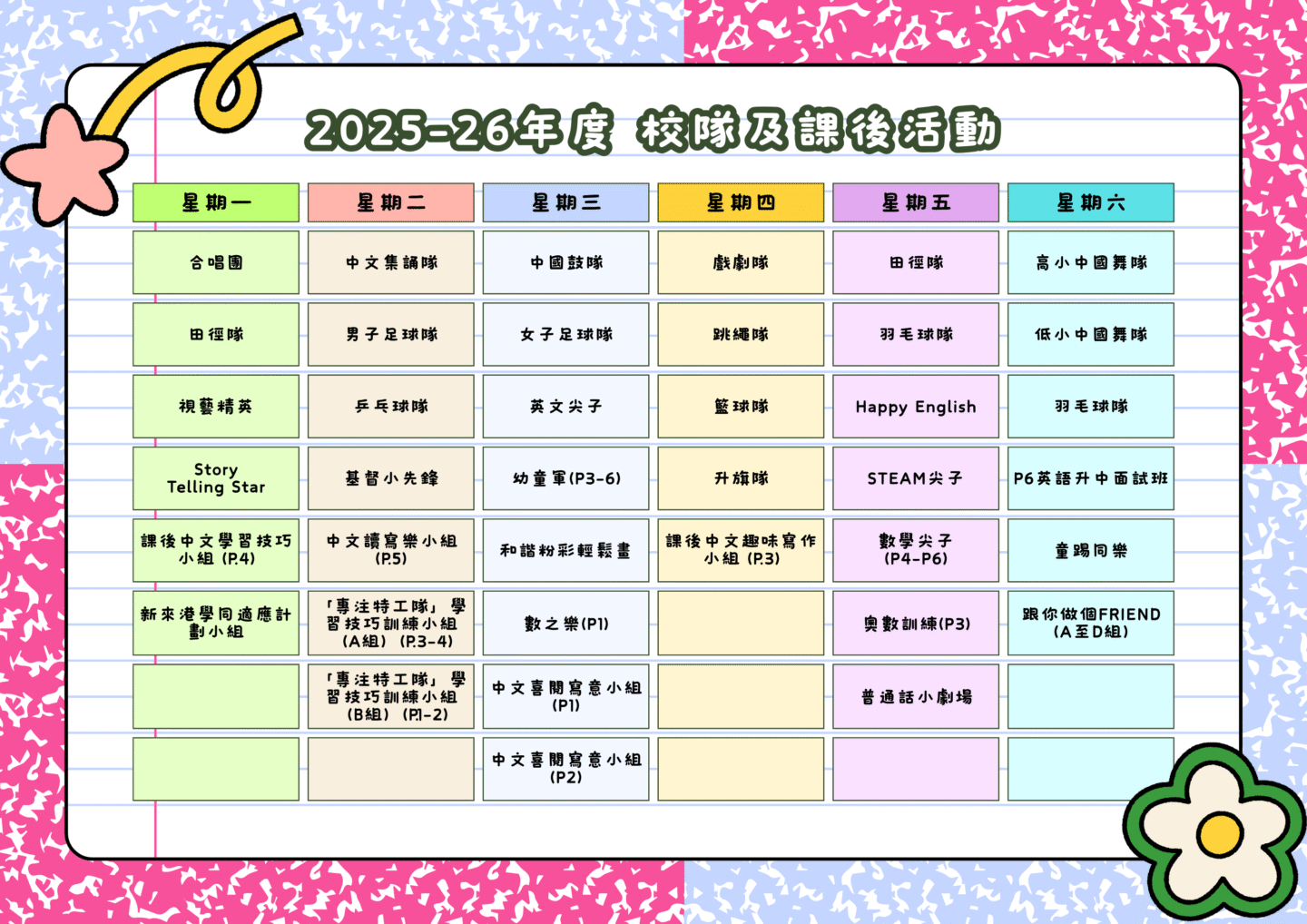
2025–2026 School Year — School Teams and After-school Activities
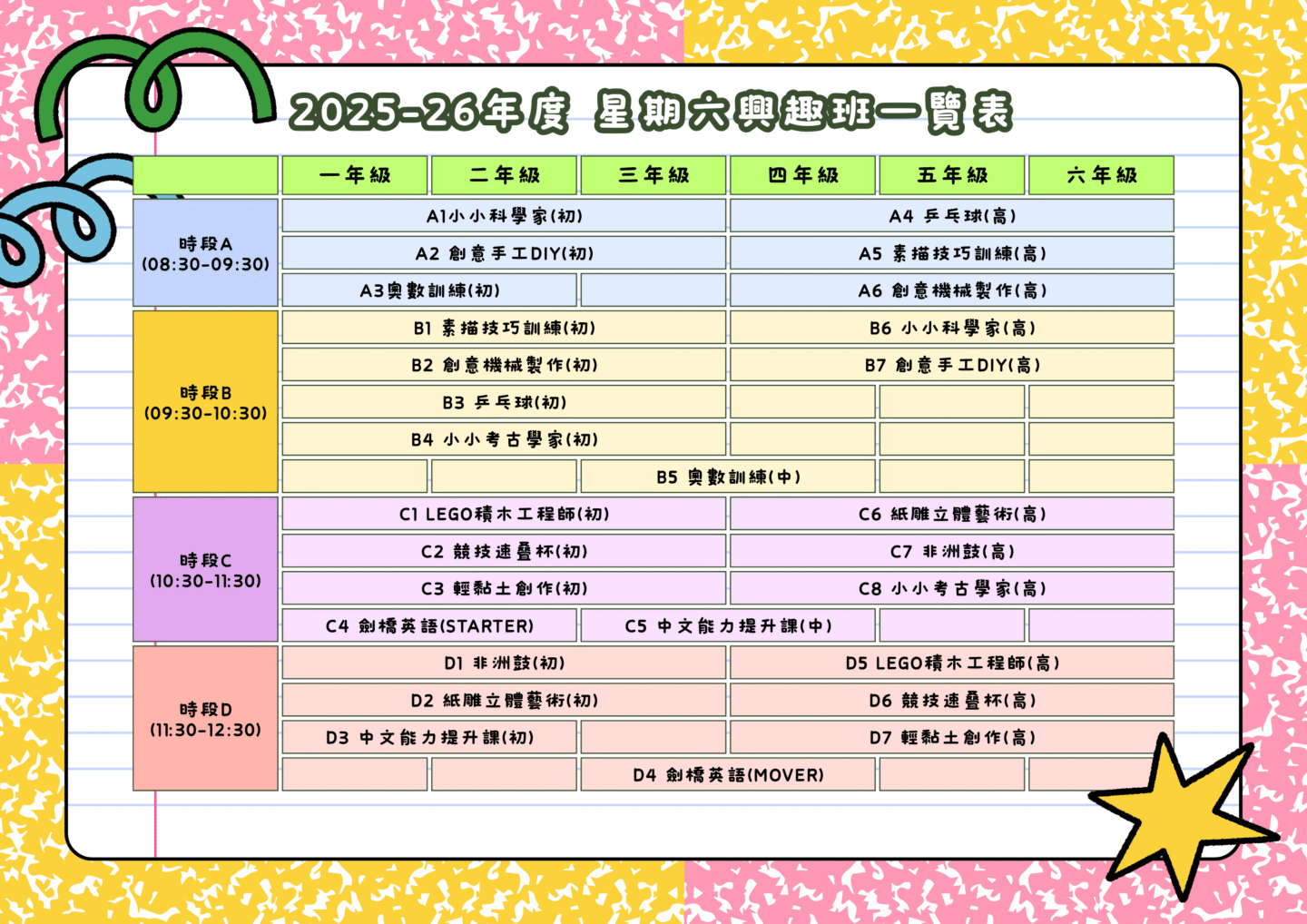
Saturday Extracurricular Interest Classes
2025–2026 School Year Saturday Extracurricular Interest Classes